Boston College Athletics
Reliving BC's Notre Dame Win Streak 15 Years Later
September 14, 2017 | Football, #ForBoston Files
Video: Addazio Media Availability (Sept. 12)Video: Brown Media Availability (Sept. 12)VIdeo: Dillon Media Availability (Sept. 12)Video: Landry Media Availability (Sept. 12)Video: Addazio Weekly Press Conference (Sept. 11)
The wins elevated the Eagles to equal footing with one of football's most historic programs
In the late 1990s, the Holy War wasn't a rivalry as it was a rite of passage. An annual matchup between Boston College and Notre Dame, the participants represented the only two Catholic schools sponsoring football at the highest collegiate level. In a city with as deep of an Irish Catholic culture as Boston, the interlocking ND always seemed to have a home, creating a natural rivalry between the two schools.
Through those years, however, it was more one-sided than even matchup. Even with back-to-back victories in 1993 and 1994, the Eagles didn't ever beat the Fighting Irish. Even with well-competed games, the "David Gordon Game" pushed further into the rearview by Notre Dame's fifth straight win in 1998.
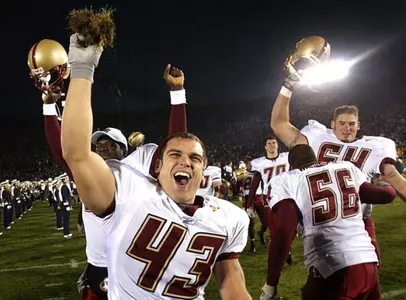
But 15 years ago, everything changed. Starting in 2001, BC kicked off a stretch of six straight wins over Notre Dame. Coupled with a win in 1999, the Eagles won seven of eight games, leveling the perceived playing field.
"We always had a chip on our shoulder as a group," former defensive end Mathias Kiwanuka said. "We never felt like underdogs, but everything that was always written was so one-sided. We always felt like Notre Dame didn't view us as rivals because they were a good team and were cocky. But we brought talent, heart, grit and a focus to the table. We had a lot of camaraderie, which helped. When we won, we didn't feel shocked because we felt like we could handle any opponent we played against."
Though the schools are in different time zones, it was common to grow up in Massachusetts as Notre Dame fans. The Fighting Irish were on national television at a time when games weren't widely available, and their success made them an easy target with their leprechaun mascot and religious heritage.
"Notre Dame has a huge following in Boston," said former Eagle quarterback Brian St. Pierre. "I even grew up a fan of Notre Dame. The region has a huge Irish population, which contributes to it. But I stopped liking them once I got to BC, and that love for Notre Dame only wound up adding fuel to the fire (for us)."
"Boston is a big Irish Catholic town, so locally the Holy War game was always a big deal," former running back Derrick Knight said. "When I first got to BC, it was always a big game. You always circled every game on your calendar, but Notre Dame didn't have to be circled. Everyone was focused on it, and it got everyone on campus going."
Despite deep roots, the series remained incredibly one-sided even with an Eagle victory in 1999. The Irish rallied for a 28-16 victory in 2000, improving them to 9-3 all-time against BC.
Everything changed shortly thereafter. In 2001, St. Pierre threw for two touchdowns as BC beat the Irish at home, 21-17.
Then came 2002. An undefeated Notre Dame donned green jerseys in South Bend for what they hoped would help pave the road to a national championship. Instead, the Maroon and Gold shut down the "Return to Glory" with a 14-7 victory.
"We were lucky to play in that forum," linebacker Josh Ott said. "We were all pumped up to play at Notre Dame, and we had a mentality that we would win that game from the first snap. When we saw them come out in their green jerseys, it sort of validated us. It made us feel that they had to use those jerseys on us because we were a rival. And it was a great opportunity for our program."
Ott provided arguably the biggest play in '02 when he returned a Pat Dillingham pass 71 yards for a touchdown. It wound up as the difference maker and the game winning touchdown. Earlier in the game, he recovered a fumble that led directly to BC's other touchdown.
"We had been coming together as a program," Ott said. "We had been to a bowl game and been blown out (in 1999). Then we started winning some games, putting together a nice streak. But Notre Dame always seemed to discredit us. Up until then, nobody thought of us a real rival. Then we started winning those games."
The wins shifted the tides. In 2003, BC found a way to beat the Irish again, then again in 2004, both times by less than a field goal. After a short hiatus when the Eagles moved to the ACC, they renewed the series in 2007. By then, Boston College was the national powerhouse, a top-ranked team who decisively beat their rival.
"Every year, teams are different," Knight said. "We were always underdogs, and we never had that upper echelon view. But we knew that the tide was shifting. When I left BC, Notre Dame still commanded a ton of respect, but the main circles on our calendar became teams that we wanted to compete against to win a conference championship - teams like Miami and Virginia Tech."
In the early 2000s, the streak helped make the Holy War must-see theater on a national scale. "Both Jeremy Trueblood and I were from Indianapolis, so we grew up where everything was Notre Dame everything," Kiwanuka said. "Playing at Notre Dame, I made it a mission that I wasn't going home to lose. Notre Dame was everywhere; even my family in Uganda had heard of them. I couldn't escape it, and they had a storied program and great school. A lot of people I grew up with wanted to go there. But specifically for defense, we knew we faced NFL caliber players in our practice and we had no fear. We knew we were just as good every day.
"It was a great opportunity," he continued. "There were millions of people watching that rivalry. As a football player, you lay in bed dreaming of those types of crowds like the ones we played against with Notre Dame. It was our rival, and we had fun. We took our opportunities and did a tremendous job to carry on our tradition and elevate our traditions. I loved every minute, from playing at home to playing out there."
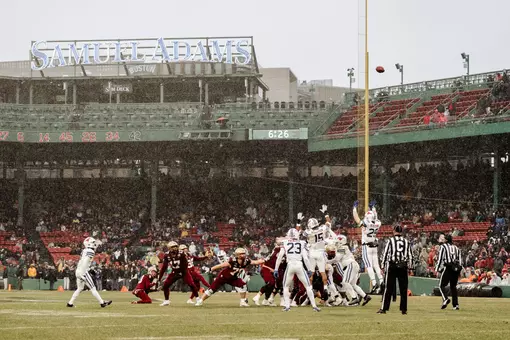
The Eagles and Irish don't play annually anymore. Conference realignment and new forms of scheduling kept the teams apart in 2013 and 2014, and 2015's Shamrock Series game at Fenway Park is the only other matchup since 2012 before this season. It's not the same as the early 2000s, and the alumni all recognized the development of new, ACC rivalries with teams like Clemson and Florida State.
Having Notre Dame on the schedule, however, still provides the same juice as it did 15 years ago.
"We always felt like we were tougher, and we knew we could play," St. Pierre said. "When I left BC, we won three out of four years. We started a streak of six straight wins against Notre Dame. We enjoyed playing them, and we enjoyed beating them. Our MO became that we could win those games. It was one of the first games we circled along with Miami, Virginia Tech and Syracuse."
"Those wins were huge," Kiwanuka said. "You had to play well against those teams. There was always talk of Notre Dame coming off our schedule, so you had to be up for those games. The torch was passed to us, and winning those games reassured that we could pass the torch to the next group."
Through those years, however, it was more one-sided than even matchup. Even with back-to-back victories in 1993 and 1994, the Eagles didn't ever beat the Fighting Irish. Even with well-competed games, the "David Gordon Game" pushed further into the rearview by Notre Dame's fifth straight win in 1998.
But 15 years ago, everything changed. Starting in 2001, BC kicked off a stretch of six straight wins over Notre Dame. Coupled with a win in 1999, the Eagles won seven of eight games, leveling the perceived playing field.
"We always had a chip on our shoulder as a group," former defensive end Mathias Kiwanuka said. "We never felt like underdogs, but everything that was always written was so one-sided. We always felt like Notre Dame didn't view us as rivals because they were a good team and were cocky. But we brought talent, heart, grit and a focus to the table. We had a lot of camaraderie, which helped. When we won, we didn't feel shocked because we felt like we could handle any opponent we played against."
Though the schools are in different time zones, it was common to grow up in Massachusetts as Notre Dame fans. The Fighting Irish were on national television at a time when games weren't widely available, and their success made them an easy target with their leprechaun mascot and religious heritage.
"Notre Dame has a huge following in Boston," said former Eagle quarterback Brian St. Pierre. "I even grew up a fan of Notre Dame. The region has a huge Irish population, which contributes to it. But I stopped liking them once I got to BC, and that love for Notre Dame only wound up adding fuel to the fire (for us)."
"Boston is a big Irish Catholic town, so locally the Holy War game was always a big deal," former running back Derrick Knight said. "When I first got to BC, it was always a big game. You always circled every game on your calendar, but Notre Dame didn't have to be circled. Everyone was focused on it, and it got everyone on campus going."
Despite deep roots, the series remained incredibly one-sided even with an Eagle victory in 1999. The Irish rallied for a 28-16 victory in 2000, improving them to 9-3 all-time against BC.
Everything changed shortly thereafter. In 2001, St. Pierre threw for two touchdowns as BC beat the Irish at home, 21-17.
Then came 2002. An undefeated Notre Dame donned green jerseys in South Bend for what they hoped would help pave the road to a national championship. Instead, the Maroon and Gold shut down the "Return to Glory" with a 14-7 victory.
"We were lucky to play in that forum," linebacker Josh Ott said. "We were all pumped up to play at Notre Dame, and we had a mentality that we would win that game from the first snap. When we saw them come out in their green jerseys, it sort of validated us. It made us feel that they had to use those jerseys on us because we were a rival. And it was a great opportunity for our program."
Ott provided arguably the biggest play in '02 when he returned a Pat Dillingham pass 71 yards for a touchdown. It wound up as the difference maker and the game winning touchdown. Earlier in the game, he recovered a fumble that led directly to BC's other touchdown.
"We had been coming together as a program," Ott said. "We had been to a bowl game and been blown out (in 1999). Then we started winning some games, putting together a nice streak. But Notre Dame always seemed to discredit us. Up until then, nobody thought of us a real rival. Then we started winning those games."
The wins shifted the tides. In 2003, BC found a way to beat the Irish again, then again in 2004, both times by less than a field goal. After a short hiatus when the Eagles moved to the ACC, they renewed the series in 2007. By then, Boston College was the national powerhouse, a top-ranked team who decisively beat their rival.
"Every year, teams are different," Knight said. "We were always underdogs, and we never had that upper echelon view. But we knew that the tide was shifting. When I left BC, Notre Dame still commanded a ton of respect, but the main circles on our calendar became teams that we wanted to compete against to win a conference championship - teams like Miami and Virginia Tech."
In the early 2000s, the streak helped make the Holy War must-see theater on a national scale. "Both Jeremy Trueblood and I were from Indianapolis, so we grew up where everything was Notre Dame everything," Kiwanuka said. "Playing at Notre Dame, I made it a mission that I wasn't going home to lose. Notre Dame was everywhere; even my family in Uganda had heard of them. I couldn't escape it, and they had a storied program and great school. A lot of people I grew up with wanted to go there. But specifically for defense, we knew we faced NFL caliber players in our practice and we had no fear. We knew we were just as good every day.
"It was a great opportunity," he continued. "There were millions of people watching that rivalry. As a football player, you lay in bed dreaming of those types of crowds like the ones we played against with Notre Dame. It was our rival, and we had fun. We took our opportunities and did a tremendous job to carry on our tradition and elevate our traditions. I loved every minute, from playing at home to playing out there."
The Eagles and Irish don't play annually anymore. Conference realignment and new forms of scheduling kept the teams apart in 2013 and 2014, and 2015's Shamrock Series game at Fenway Park is the only other matchup since 2012 before this season. It's not the same as the early 2000s, and the alumni all recognized the development of new, ACC rivalries with teams like Clemson and Florida State.
Having Notre Dame on the schedule, however, still provides the same juice as it did 15 years ago.
"We always felt like we were tougher, and we knew we could play," St. Pierre said. "When I left BC, we won three out of four years. We started a streak of six straight wins against Notre Dame. We enjoyed playing them, and we enjoyed beating them. Our MO became that we could win those games. It was one of the first games we circled along with Miami, Virginia Tech and Syracuse."
"Those wins were huge," Kiwanuka said. "You had to play well against those teams. There was always talk of Notre Dame coming off our schedule, so you had to be up for those games. The torch was passed to us, and winning those games reassured that we could pass the torch to the next group."
Friday, September 25
Thursday, September 24
Thursday, September 24
Thursday, September 24