Boston College Athletics
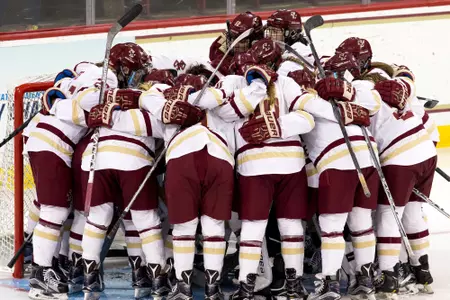
Photo by: Rich Gagnon
In Kelley Rink, Olympic Tradition Pours Foundation for Success
October 03, 2017 | Women's Hockey, #ForBoston Files
Women's hockey is now synonymous with Team USA's gold medal quest.
When Katie Crowley became head coach of the Boston College women's hockey program in 2007, the sport itself had a very different look. Though the Eagles had back-to-back 20-win seasons on their resume, they weren't the type of embedded power as the western college hockey programs were. Even with a Frozen Four appearance, BC wasn't on par historically with the pre-NCAA era teams of places like Harvard.
A decade later, though, the Eagles stand at the forefront of the sport's growth and renaissance. They've won no fewer than 24 games every year since 2010-2011 and won 40 games in 2015-2016. When the NCAA first sponsored a women's hockey national championship in 2001, BC lost 26 games. Since the start of the 2012-13 season, it's only lost 24 ... combined.
That BC is a symbol of success is no accident. Crowley's system laid the foundation for a dynasty by encouraging competition at the highest possible level. By developing Olympians, Boston College is now synonymous with elite excellence with the talent capable to lift the program to its first ever national championship.
"Building a team is a puzzle," Crowley said. "We look to get the right pieces. We know that we can't have the same type of player at every position, and we know that we need to find those right puzzle pieces for each year. It's becoming even more challenging because recruiting is getting earlier and earlier. For us, we know that we're also looking for people who can fit the role of the BC athlete and everything that goes into it - academics, athletics and socially."
In 2010, BC went 8-17-10 for its first losing season since 2004-05. Since then, the program is 204-41-22. There's only been one season where the team lost 10 games, and this year marks the quest for a seventh Frozen Four appearance in the last eight seasons (all of which featured national tournament qualifications).
"We've been fortunate to have had some really deep teams through the years," Crowley said. "We've seen players step into roles and play those roles well. In the past, that's been the case when we've lost some players. Someone else can step in and log the minutes that someone played before them."
Losing players is part of college sports, but BC seems to lose players every four years for an entirely different reason. For the third straight Winter Olympic cycle, the Eagles will be without active players who take a year-long leave of absence from school and compete with the national team starting in late summer through the Olympics.
In 2010, Molly Schaus and Kelli Stack left BC for the year to play for Team USA in Vancouver. Four years later, Alex Carpenter wore the Red, White and Blue in Sochi, Russia. This year, the opportunity to represent the United States will once again take part of the BC roster by borrowing Megan Keller and Kali Flanagan from the blue line.
"We've used the experience (of past Olympics) to become deeper," Crowley said. "We feel we have defensemen who can and will need to step up into the roles that Megan and Kali both have played. The best part of our sport is that we get players back, so we know they're coming back to BC at some point. When the men play in the Olympics, they turn pro. So for us, it's nice to see players get to that highest level, and then it's even better when we see them come back - and how they develop playing at that level."
The Olympic opportunity might initially hurt BC, but it opens opportunistic doors on the recruiting trail. With four former or current team members on Team USA, the Eagles offer a unique chance to reach the pinnacle of women's hockey play. While Keller and Flanagan are current Eagles currently on loan, Emily Pfalzer joins Carpenter as former BC superstars fighting for gold.
"The Olympics is the highest level for women's hockey," Crowley said. "A lot of players obviously then want to try out and play for the Olympic team. That's something we keep in the back of our heads when we're recruiting a player. We have to be diligent with that perspective, and we have to take care of things from a scholarship standpoint to make sure it can still be a possibility."
It keeps the machine churning in Conte Forum. Even though it loses high-caliber athletes in Keller and Flanagan, BC enters this weekend ranked No. 3 in the nation. The Eagles are expected to compete among the national contenders, but they understand they have to still compete. Because only eight teams make the national tournament, every game becomes critical.
"The early returns have been pretty good for this team," Crowley said. "We're seeing what various people can do in different roles. We've been pleased to see the freshmen step in and do well; we counterbalance four seniors with four freshmen so we're relatively young with a heavy sophomore and junior class. But we're excited, and the leaders have done a good job getting us ready."
For BC, the "Road To Ridder" begins this weekend against women's hockey's oldest powerhouse. A five-time national champion, Minnesota Duluth finished last season as the No. 3 overall seed in the NCAA Tournament, losing in the Quarterfinals to their archrival, Minnesota. The Bulldogs enter this weekend ranked No. 4, making this college hockey's first Top-5 matchup of the year.
"We're very excited to see a team from the WCHA because we usually don't see them," Crowley said. "They were very prepared for us last year and ready from the get go. They have a couple of games in hand already played over us. They're a very good team, but we're excited to get started (on our season).
A decade later, though, the Eagles stand at the forefront of the sport's growth and renaissance. They've won no fewer than 24 games every year since 2010-2011 and won 40 games in 2015-2016. When the NCAA first sponsored a women's hockey national championship in 2001, BC lost 26 games. Since the start of the 2012-13 season, it's only lost 24 ... combined.
That BC is a symbol of success is no accident. Crowley's system laid the foundation for a dynasty by encouraging competition at the highest possible level. By developing Olympians, Boston College is now synonymous with elite excellence with the talent capable to lift the program to its first ever national championship.
"Building a team is a puzzle," Crowley said. "We look to get the right pieces. We know that we can't have the same type of player at every position, and we know that we need to find those right puzzle pieces for each year. It's becoming even more challenging because recruiting is getting earlier and earlier. For us, we know that we're also looking for people who can fit the role of the BC athlete and everything that goes into it - academics, athletics and socially."
In 2010, BC went 8-17-10 for its first losing season since 2004-05. Since then, the program is 204-41-22. There's only been one season where the team lost 10 games, and this year marks the quest for a seventh Frozen Four appearance in the last eight seasons (all of which featured national tournament qualifications).
"We've been fortunate to have had some really deep teams through the years," Crowley said. "We've seen players step into roles and play those roles well. In the past, that's been the case when we've lost some players. Someone else can step in and log the minutes that someone played before them."
Losing players is part of college sports, but BC seems to lose players every four years for an entirely different reason. For the third straight Winter Olympic cycle, the Eagles will be without active players who take a year-long leave of absence from school and compete with the national team starting in late summer through the Olympics.
In 2010, Molly Schaus and Kelli Stack left BC for the year to play for Team USA in Vancouver. Four years later, Alex Carpenter wore the Red, White and Blue in Sochi, Russia. This year, the opportunity to represent the United States will once again take part of the BC roster by borrowing Megan Keller and Kali Flanagan from the blue line.
"We've used the experience (of past Olympics) to become deeper," Crowley said. "We feel we have defensemen who can and will need to step up into the roles that Megan and Kali both have played. The best part of our sport is that we get players back, so we know they're coming back to BC at some point. When the men play in the Olympics, they turn pro. So for us, it's nice to see players get to that highest level, and then it's even better when we see them come back - and how they develop playing at that level."
The Olympic opportunity might initially hurt BC, but it opens opportunistic doors on the recruiting trail. With four former or current team members on Team USA, the Eagles offer a unique chance to reach the pinnacle of women's hockey play. While Keller and Flanagan are current Eagles currently on loan, Emily Pfalzer joins Carpenter as former BC superstars fighting for gold.
"The Olympics is the highest level for women's hockey," Crowley said. "A lot of players obviously then want to try out and play for the Olympic team. That's something we keep in the back of our heads when we're recruiting a player. We have to be diligent with that perspective, and we have to take care of things from a scholarship standpoint to make sure it can still be a possibility."
It keeps the machine churning in Conte Forum. Even though it loses high-caliber athletes in Keller and Flanagan, BC enters this weekend ranked No. 3 in the nation. The Eagles are expected to compete among the national contenders, but they understand they have to still compete. Because only eight teams make the national tournament, every game becomes critical.
"The early returns have been pretty good for this team," Crowley said. "We're seeing what various people can do in different roles. We've been pleased to see the freshmen step in and do well; we counterbalance four seniors with four freshmen so we're relatively young with a heavy sophomore and junior class. But we're excited, and the leaders have done a good job getting us ready."
For BC, the "Road To Ridder" begins this weekend against women's hockey's oldest powerhouse. A five-time national champion, Minnesota Duluth finished last season as the No. 3 overall seed in the NCAA Tournament, losing in the Quarterfinals to their archrival, Minnesota. The Bulldogs enter this weekend ranked No. 4, making this college hockey's first Top-5 matchup of the year.
"We're very excited to see a team from the WCHA because we usually don't see them," Crowley said. "They were very prepared for us last year and ready from the get go. They have a couple of games in hand already played over us. They're a very good team, but we're excited to get started (on our season).
Players Mentioned

D
/ Women's HockeyD
/ Women's HockeySaturday, August 29
Saturday, August 29
Thursday, August 27
Wednesday, August 26